Protecting Floor Warranties Before Concrete Is Poured
Moisture problems in concrete slabs can wreck beautiful floors and wreck relationships on a project. In Orange County, we see it all the time, from buckling wood in luxury homes to bubbles in resilient flooring in busy commercial spaces. When moisture vapor pushes up into the flooring system, finishes fail, warranties get questioned, and fingers start pointing.
That is why enforceable pre-flooring moisture testing specs are no longer a "nice idea." They are part of risk management for every architect, designer, and general contractor working with high-end finishes and tight construction schedules. When the specs are clear, aligned with ASTM F2170 and F1869, and backed by an actual responsibility matrix, everyone knows what must happen before a single plank, tile, or roll hits the slab.
In this guide, we walk through how Orange County specifiers can write clear, enforceable language that fits real job conditions, supports flooring manufacturer warranties, and lowers the chance of moisture-related failures.
Why Orange County Specs Fail Under Real Project Pressure
On paper, most specs look fine. The trouble shows up when the job hits that late-year push to get floors in and spaces turned over before the holidays. At that point, weak spec language gets tested, and it often breaks.
Common failure points we see in local specs include:
- Vague phrases like "test concrete moisture as required" with no method or standard
- Conflicting messages between drawings, Division 03, and Division 09 notes
- Old copy-and-paste sections that ignore specific flooring manufacturer requirements
- No cross-check between adhesives, flooring materials, and their different limits
Southern California slabs can fool people. Fall and early winter bring cooler nights and higher coastal humidity. Buildings get enclosed, HVAC runs on and off, and everyone assumes the slab is "old enough" to be dry. But without real testing, that is just a guess.
When specs do not assign clear roles and timing, enforcement problems show up fast:
- No named party responsible for hiring the testing agency
- No testing schedule tied to project milestones
- No submittal requirements for test reports or mitigation plans
- No stated acceptance criteria linked to the actual flooring system
In that gap, each party can claim the other should have caught the risk. That is exactly what leads to disputes and potential warranty trouble.
Writing Clear ASTM F2170 and F1869 Spec Language
ASTM F2170 and ASTM F1869 are the core standards for concrete moisture testing before flooring goes down. When we talk to spec writers in Orange County, we keep the focus on what each one covers and why both still show up in many flooring warranties.
In simple terms:
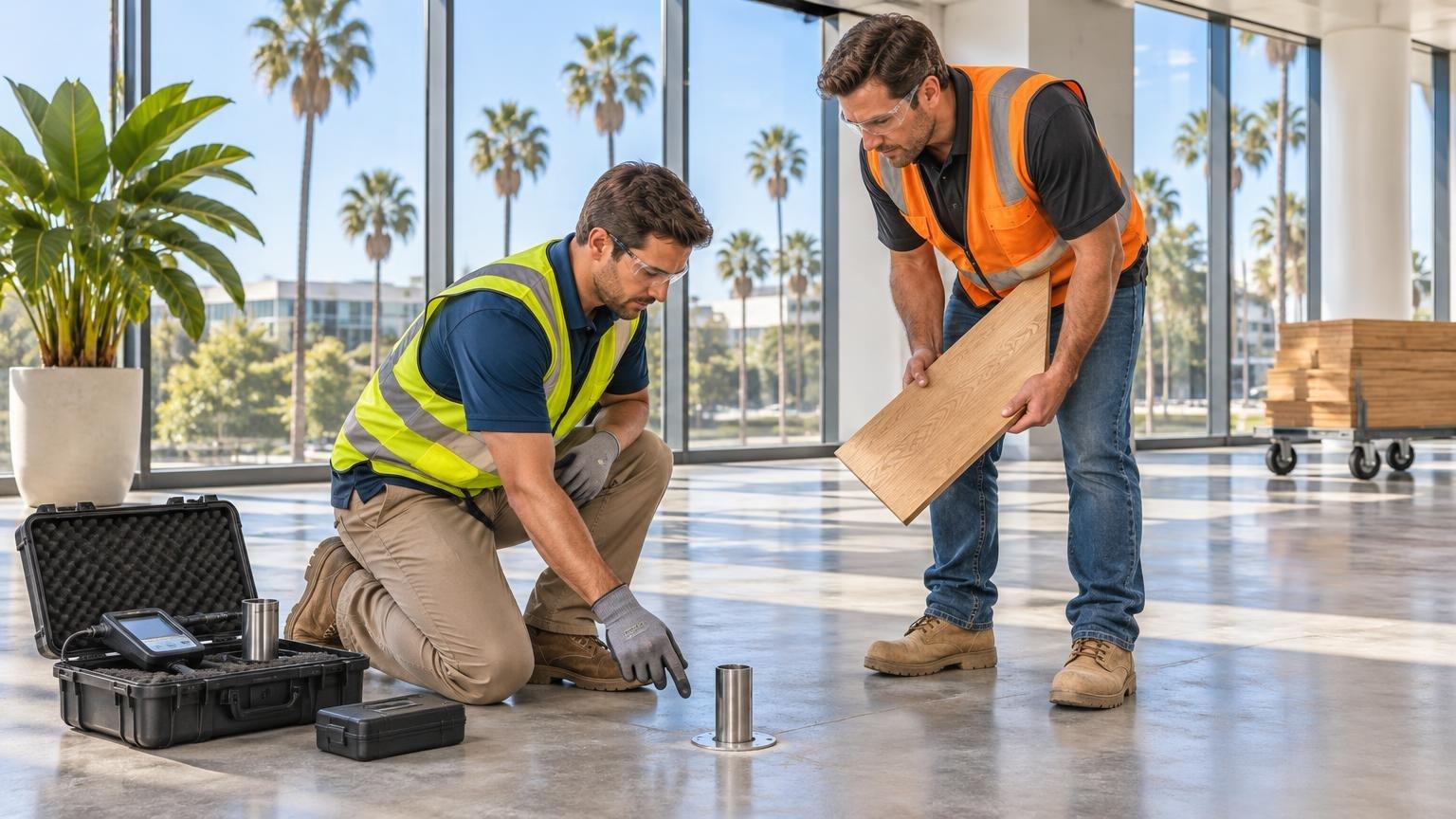
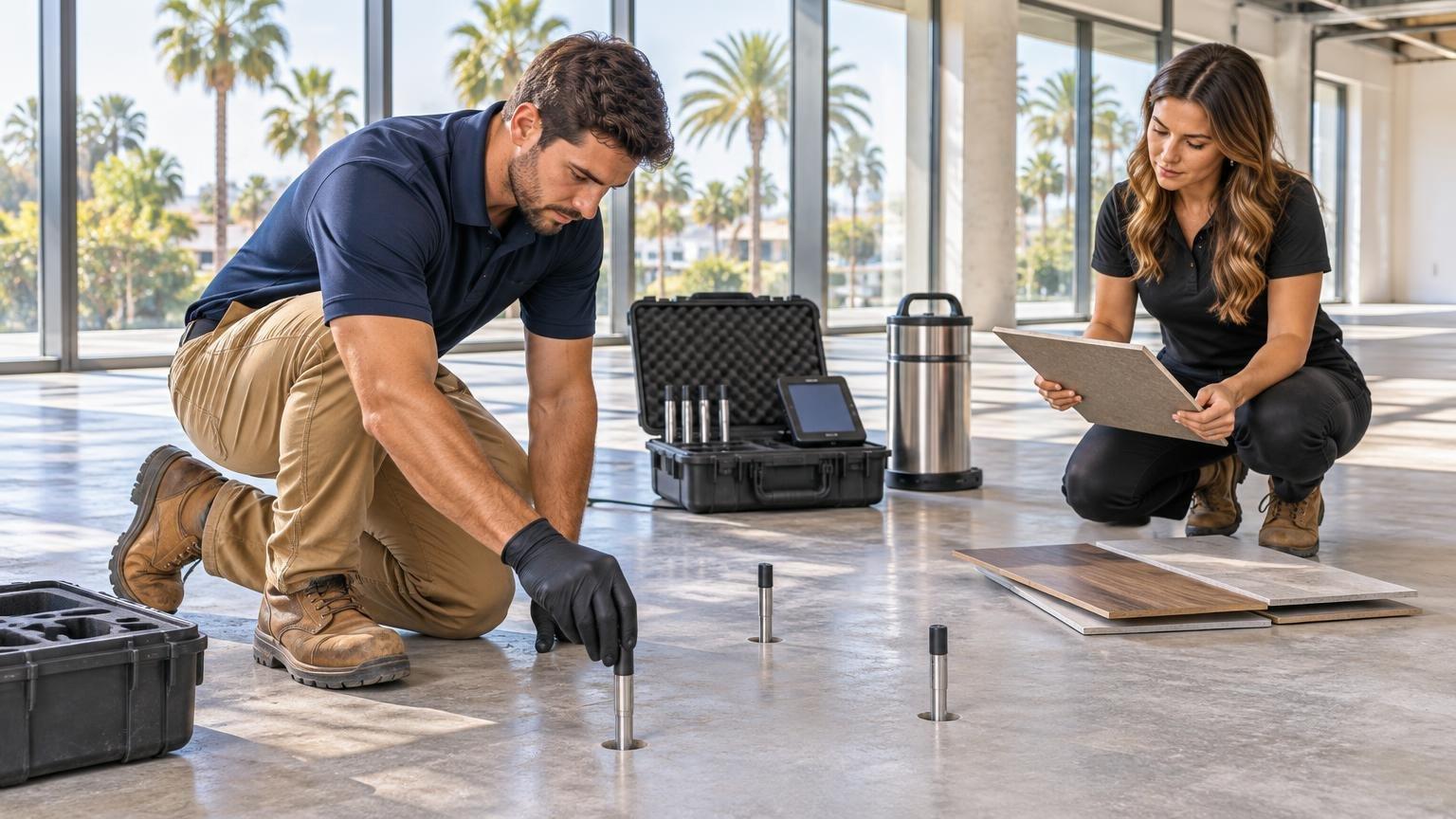
- ASTM F2170 governs in-situ relative humidity testing inside the concrete slab
- ASTM F1869 governs moisture vapor emission rate (MVER) using calcium chloride kits
Many flooring and adhesive manufacturers now lean more heavily on F2170 results, but some still want both test methods. The spec should match what the actual products require.
To keep specs clear and enforceable, we suggest language that:
- Names each test method by full standard name and current designations
- Sets a minimum test density, like a certain number of tests per square foot and per distinct area
- Calls out specific locations to test, such as entries, wet areas, and near control joints
- Requires an independent third party that is not tied to the flooring installer or supplier
It also helps to treat moisture as a coordinated topic across Divisions:
- Division 01: General requirements, testing, and responsibility matrix
- Division 03: Concrete mix, curing, and any vapor retarder or moisture control system
- Division 09: Flooring products, adhesive limits, and final acceptance thresholds
When these sections agree with each other, the contractor gets one clear message instead of a puzzle.
Building a Responsibility Matrix That Sticks in the Field
A responsibility matrix sounds formal, but it can be very simple. The goal is to put in writing who does what and when for pre-flooring moisture testing in Orange County projects.
A basic role breakdown looks like this:
- Architect or specifier: Defines test methods, timing, and required thresholds
- General contractor: Schedules and pays for testing, sets up site conditions, and coordinates trades
- Independent testing agency: Performs ASTM-compliant RH, MVER, and pH testing and reports results
- Flooring installer: Reviews results, confirms compatibility with products, and flags concerns
We like to see this captured in a short table in Division 01 that ties each action to a party and milestone, for example:
- Pre-construction review of flooring system requirements: Architect and GC
- Initial testing after enclosure and HVAC start-up: GC and testing agency
- Review of test reports and mitigation decision: GC, architect, and owner
- Re-testing after mitigation: GC and testing agency
This kind of matrix really helps when schedules tighten around the year-end occupancy push. It is much harder for anyone to skip, rush, or ignore testing when tasks are clearly assigned and tied to specific points in the schedule.
Submittals and Acceptance Criteria That Protect Warranties
Strong submittal and acceptance sections turn your spec from a wish list into an enforceable process. They also protect the project team when a moisture issue shows up after installation.
Key submittals to include:
- Pre-flooring review that confirms manufacturer moisture limits and required test methods
- Certified test reports listing RH, MVER, and pH results, along with test locations and dates
- Ambient and slab temperature readings and confirmation of site conditions at the time of testing
- Documentation of test equipment calibration from the testing agency
- Written mitigation recommendations when readings exceed limits
Acceptance criteria should not be generic, like a single RH limit for all floors. Instead, tie them to each flooring system and adhesive. If one product allows a certain RH and another requires a lower number, write that clearly and link it to the test method.
For borderline results near the upper limit, require written acknowledgment from the flooring manufacturer. That way, if there is a claim later, there is a record that the installation took place with the manufacturer fully informed.
Timing matters just as much as numbers. Moisture testing should:
- Happen after the building is enclosed
- Take place with HVAC running in conditions that match expected use as closely as practical
- Be repeated after any moisture mitigation or major schedule shift that might affect slab conditions
This is especially important during late-year work, when indoor conditions can change as crews wind down and spaces shift from construction to near-occupancy use.
Turning Better Specs Into Fewer Moisture Claims
Clear, enforceable moisture testing specs will not remove all risk, but they can greatly lower the chance of surprise failures and tense meetings around damaged floors. When the test methods are spelled out, the roles are assigned, and the acceptance criteria match actual products, everyone has a shared playbook.
For Orange County specifiers and general contractors, the quiet success story is the project where flooring goes in once and stays put. Fewer callbacks, fewer change orders tied to emergency mitigation, and less blame-shifting all start with careful spec language and a realistic view of how slabs dry on real jobs.
As an independent testing partner based here in Orange County, we at Concrete Moisture Testing Orange County see how small changes in specs can make a big difference in the field. When pre-flooring moisture testing in Orange County is planned early, done to ASTM standards, and backed by a clean paper trail, it protects finishes, budgets, and warranties long after the project turns over.
Get Started With Your Project Today
Protect your flooring investment by scheduling reliable pre-flooring moisture testing in Orange County before any materials are installed. At Concrete Moisture Testing Orange County, we provide accurate data so you can make confident decisions and avoid costly failures. Reach out today to discuss your project timeline, and if you are ready to move forward, you can contact us to book your testing appointment.