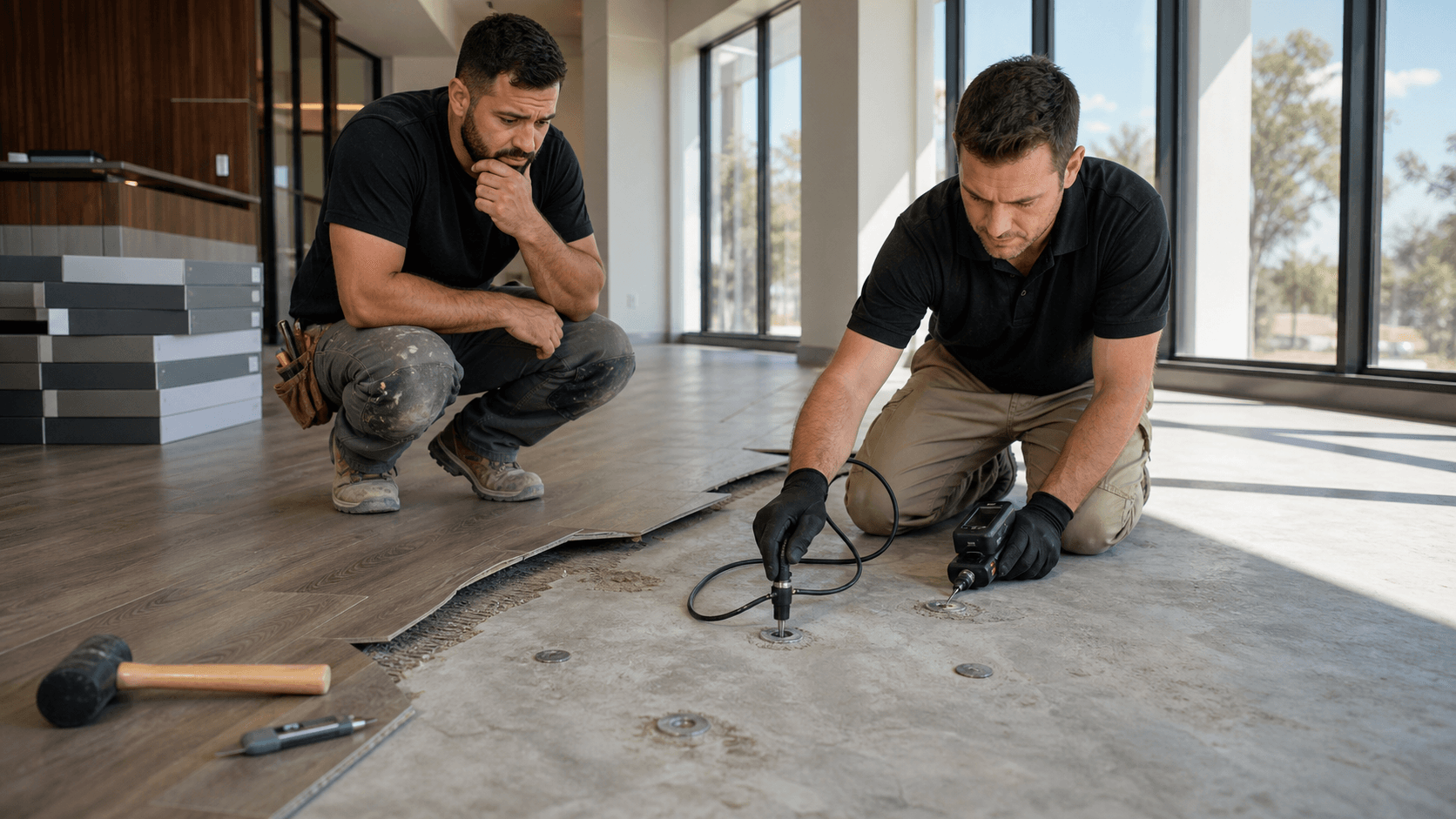
Raise Quality Standards on Every Irvine Flooring Project
Clear Division 01 language can make or break a flooring project in Irvine. When the quality requirements for third-party concrete moisture testing are vague, people guess, cut corners, or test too early. That is when schedules slip, warranties get messy, and floors fail before they should.
In Irvine, owners expect quiet, flat, beautiful floors in offices, retail, and luxury homes. A moisture-related failure can stain a brand, upset tenants, and force expensive tear-outs. Good specs protect everyone, from the architect to the installer.
Here, we walk through a practical "Irvine spec template" for pre-flooring moisture testing in Irvine. We focus on Division 01 language for scope, submittals, reporting format, and acceptance criteria so quality control is clear long before the first box of flooring arrives.
Defining the Scope of Independent Moisture Testing
Division 01 should make it crystal clear when third-party moisture testing is required. Do not leave it to guesswork in the field.
In most Irvine projects, testing should be required for:
- All slab-on-grade under resilient, wood, or textile flooring
- Podium and elevated structural decks with finished flooring
- Lightweight concrete or toppings used as underlayment
A waiver for testing should never be allowed when:
- Flooring manufacturers require RH, MVER, or pH testing
- There is no verified vapor retarder below the slab-on-grade
- High-end or warranty-sensitive flooring is specified
To avoid conflicts of interest, Division 01 should define "independent testing agency" as a firm that:
- Has no financial relationship with the flooring installer or flooring manufacturer
- Uses ASTM-compliant equipment and methods
- Provides documentation of training specific to concrete moisture testing
- Holds insurance appropriate for commercial work in Irvine
Orange County climate adds another layer. Heat, coastal humidity, and nighttime marine layer all affect how slabs dry. Specs should require testing close to the actual installation date, not months in advance, so results match real site conditions when flooring goes down.
Division 01 Submittals That Prevent Moisture Surprises
The right submittals in Division 01 help the team see moisture risk early, not at the eleventh hour.
Before construction, require submittals such as:
- Testing agency qualifications and proof of independence
- A sample moisture test report showing format and data points
- Written procedures for ASTM F2170 (RH), F1869 (MVER), and pH testing
- Calibration certificates for meters and probes
- Sample chain-of-custody form for test data and samples
During construction, require:
- A test location plan that lines up with floor finish plans and room names
- A testing schedule tied to slab placements, curing, and HVAC startup
- A notice procedure so the GC and owner are informed if early readings are high
When Division 01 spells these out, pre-flooring moisture testing in Irvine becomes a normal, planned task. The team can coordinate with flooring manufacturers, keep options open, and avoid last-minute scrambles for emergency mitigation or flooring changes.
Standardized Reporting Format for ASTM-Compliant Results
Good test data only helps if people can read and compare it easily. Division 01 should demand a clear, consistent reporting format.
Each report should include at least:
- Project name, address, and phase
- Slab area designation that matches the drawings
- Test method and version, such as ASTM F2170 or ASTM F1869
- Ambient temperature and relative humidity at time of reading
- Slab surface temperature and depth of RH probes
- Exact test locations, labeled and keyed to a floor plan
- Date and time of hole drilling or dome placement, and date and time of final readings
Spec language can require:
- Floor plans with symbols keyed to test locations
- Summary tables grouped by room or area
- RH, MVER, and pH results clearly separated so each can be checked against its own limits
To keep decisions moving, Division 01 should also set a delivery window for digital PDF reports, such as within 24 to 48 hours after final readings. That way, owners, designers, and flooring installers are not stuck waiting as schedule pressure builds.
Clear Acceptance Criteria and Contingency Actions
Generic moisture thresholds often conflict with flooring or adhesive instructions. Division 01 should say that acceptance criteria come from the actual product data sheets, not from random numbers.
You can spell it out like this in spec language:
- Moisture and pH acceptance limits must match the written requirements of the specific flooring and adhesive products selected
- If multiple products are used, the most restrictive limit in that area applies
Sometimes results are acceptable only if certain products or systems are used. For that, include conditional acceptance language, such as:
- Results are acceptable if a listed moisture mitigation system is installed
- Results are acceptable if a specified vapor retarder or primer is used under the flooring
- Results are acceptable only with a specialty adhesive rated for higher moisture levels
If the slab does not meet acceptance criteria, Division 01 should outline next steps:
- Additional testing to confirm results and define the extent of the issue
- Independent review of data and proposed mitigation options
- Mitigation design and documentation, coordinated with Division 03 and Division 09
- Formal owner approval before changing flooring types, adhesives, or adding mitigation systems
This keeps everyone on the same page and reduces finger-pointing when conditions are not ideal.
Seasonal Strategies for Late-Summer Irvine Projects
Many Irvine schedules push for fall move-ins. That means slabs are placed in spring or summer, then flooring is planned for late summer or early fall. During that time, humidity and HVAC changes can fool people into thinking the slab is dry when it is not.
Division 01 can address this by requiring:
- Permanent HVAC systems, or equivalent temporary systems, to be running before testing
- Interior temperature and relative humidity to be held near planned occupied conditions for a set period before testing
- Written confirmation from the GC that these conditions have been met
It is also smart to add a short "Seasonal Moisture Risk Allowance" note. This can encourage the project team to:
- Budget time in the schedule for possible mitigation if slabs are placed in warmer months
- Hold contingency funds for mitigation products if tests show high moisture
- Review moisture risk at preconstruction meetings when late-summer or year-end openings are targeted
Planning for seasonal risk upfront is far easier than arguing about it when flooring is about to be installed.
Put Your Irvine Moisture Testing Spec Into Action
A strong Division 01 template for independent concrete moisture testing is one of the simplest protections you can build into an Irvine project. Clear scope, defined submittals, standardized reports, and realistic acceptance criteria give everyone a shared playbook. Floors last longer, warranties stay intact, and schedules are easier to keep.
Specifiers, construction managers, and owners can start by updating their master Division 01 sections, then aligning that language with Division 03 Concrete and Division 09 Finishes. When the requirements match across divisions, there is less room for confusion in the field.
Working with a qualified third-party testing agency that understands local conditions, Irvine project expectations, and ASTM standards helps bring this all together. With the right spec language and the right partners, pre-flooring moisture testing in Irvine becomes a steady part of quality control, not a last-minute surprise.
Protect Your New Floors With Expert Moisture Testing
If you are planning a flooring installation, we can help you avoid costly failures with precise pre-flooring moisture testing in Irvine. At Concrete Moisture Testing Orange County, we use reliable, industry-standard methods to give you accurate, documented results before any materials go down. Tell us about your project and timeline, and we will recommend the right testing approach for your slab. To schedule service or request a quote, simply contact us.